


The Squeaky Wheel Needs Backup: CBS, Knight-Swift, and Why Trucking Unions Still Matter


Trucking has a strange way of calling drivers “essential” right up until one of them says no.
No, this trailer should not be on the road.
No, this load is overweight.
No, this paperwork does not match reality.
No, I am not risking my CDL so freight can keep moving.
That is where the industry’s love language changes. Suddenly the driver is not a hero. He is a problem.
CBS recently put national attention on one version of that problem: chameleon carriers. In its 60 Minutes investigation, CBS described commercial trucking fleets that shed one identity for another after safety violations, allowing bad history to disappear behind a new company name or DOT number. The story focused on Super Ego Holding and related companies, where CBS reported allegations involving corporate layers, lease-to-own contracts, dispatch pressure, safety violations, driver pay issues, and regulators struggling to keep up. (CBS News)
A separate CBS Sunday Morning-related release, published through GlobeNewswire by The Law Firm for Truck Safety, discussed a Christmas Eve crash that killed five members of an Ohio family and framed that tragedy as part of the same national conversation about chameleon carriers, broker accountability, and unsafe operators getting freight they allegedly should never have hauled. (GlobeNewswire)
My experience at Knight-Swift is not the same story. I am not saying Knight-Swift is Super Ego. I am not saying every large carrier is a chameleon carrier in the classic DOT-number-shell-game sense.
I am saying something more specific:
When a trucking system uses corporate layers, contractor labels, lease-purchase obligations, dispatch control, equipment control, and legal pressure to isolate the driver, the result can feel chameleon-like even when the logo on the trailer never changes.
And that is exactly why trucking unions mattered in the past — and why drivers at a company
like Knight-Swift could benefit from real collective power today.
What trucking unions used to do
There is a reason old-school trucking union stories still carry weight.
In 1964, the Teamsters signed the first National Master Freight Agreement. The Teamsters describe it as a milestone that provided standardized protections and benefits to more than 450,000 over-the-road and local cartage drivers across the country. (International Brotherhood of Teamsters)
That mattered because trucking is not a normal workplace. A driver is often alone, hundreds or thousands of miles from home, dealing with dispatchers, mechanics, brokers, shippers, receivers, weather, equipment problems, hours-of-service limits, scales, inspections, and a truck that can become an 80,000-pound liability in about three seconds.
A union contract did not make trucking easy. It did something more basic: it gave drivers a collective floor.
A driver with a grievance procedure is not just “complaining.”
A driver with seniority protections is not just “being difficult.”
A driver with negotiated pay rules is not begging dispatch to treat his time like it exists.
A driver with safety language in a contract has something stronger than a text message thread and a prayer.
Federal labor law still recognizes that union bargaining can cover wages, hours, vacation, insurance, safety practices, and other working conditions. (National Labor Relations Board)
That is the part modern trucking desperately needs to remember. A union is not just about hourly pay. In trucking, a union can be a safety system.
Deregulation lowered freight rates, but drivers paid part of the bill
The Motor Carrier Act of 1980 changed trucking by increasing competition and making it easier for new carriers to enter the market. President Jimmy Carter described the law at signing as bringing trucking into the “free enterprise system” and creating a strong presumption in favor of entry by new truckers and expanded service by existing firms. (The American Presidency Project)
There were real economic benefits for shippers and consumers. But the driver side of the story is uglier.
Competition did not just pressure inefficient companies. It also pressured driver pay, benefits, working conditions, and union density. More carriers could compete by cutting labor cost, pushing unpaid time onto drivers, and turning work that used to be stable employment into something closer to piecework with a steering wheel.
That is how you get the modern trucking contradiction:
The driver is legally responsible for the truck.
The carrier controls the freight.
The lease company controls the payment.
The dispatch system controls the miles.
The fuel program controls the cost.
The legal department controls the response.
And the driver is told he is “independent.”
That word can be a beautiful thing when it is real. But when independence means only that the driver carries the risk while the carrier keeps the levers, it becomes a one-way label.
My Knight-Swift story: same system, new wallet
I started at Knight as an employee driver in June 2021. In December 2021, I moved into the “independent contractor” side under a lease-to-own setup. As I wrote in my own summary, it was the same truck, a new label, and new deductions. (U-Knight.org)
That is the first place a union conversation becomes relevant.
When I became a contractor, the day-to-day operational reality did not change the way the sales pitch might make someone imagine. I was still in the same carrier ecosystem, using the same terminals, dealing with the same general chain of command, and depending on the same dispatch flow. But financially, the risk shifted. Fuel came out of my settlements. Fixed expenses became mine. Waiting time became my problem. The carrier controlled the systems that determined what I paid and what I netted. (U-Knight.org)
That is not just a pay issue. That is a safety issue.
A broke driver is easier to pressure. A driver behind on a truck payment is easier to corner. A driver who has been sitting for days with no revenue is more vulnerable when someone says, “Just run it.”
That is why labor protections and safety protections cannot be separated in trucking.

The safety paper trail Knight-Swift ignored
In August 2023, I documented a series of safety events involving Knight equipment and Knight management response.
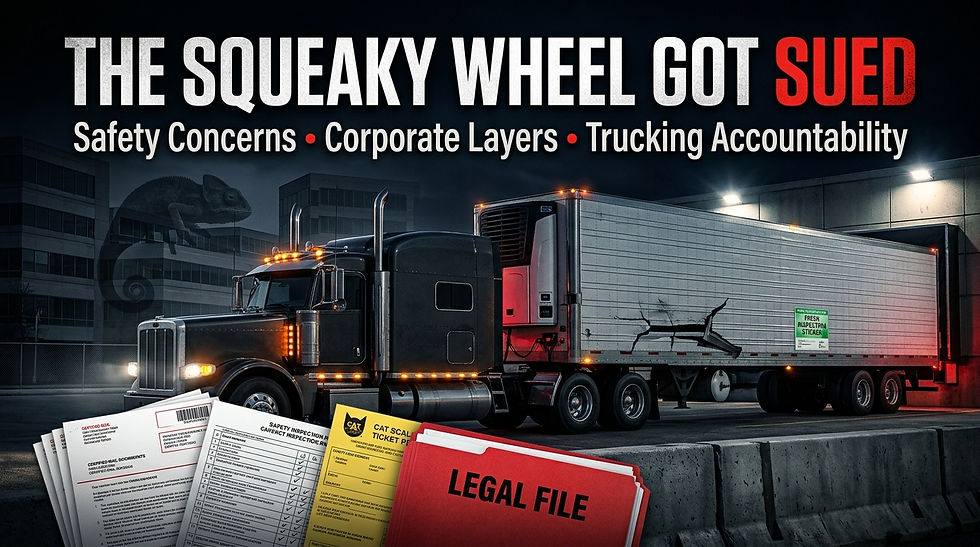
The PDF began with a trailer I picked up from Publix in Orlando and brought to Knight’s Lakeland, Florida terminal. On August 14, 2023, while I was still connected to that trailer, I noticed a brand-new Knight PM/annual inspection sticker dated that same day. According to my written account, the trailer still had visible issues, including a torn mudflap and a crack in the side rail. I emailed my terminal manager, Owner-Ops, and the VP of Safety in Phoenix. Nobody replied. I sent a follow-up two days later. No reply again.
The crack worsened on the trip from Florida toward Chicago. I stopped at the Indianapolis terminal. The load had to be transloaded. I asked for the broken trailer to be locked out or tagged so another driver would not take it. According to my PDF, that did not happen. The trailer was later found connected to another contractor’s truck.
Then came the overweight reload. After the cargo was moved into another trailer, the weight distribution was wrong. I documented the CAT scale tickets and described being told to slide the tandems and run it, with someone allegedly saying Knight would pay any tickets. I refused to haul it illegally.
A few days later, at Nestle in Indiana, I found another trailer with a bald tire during pre-trip. When I called breakdown, according to my PDF, I was asked whether I could “limp it” several miles to a Love’s because the tire still held air. I refused because it failed pre-trip and would have required interstate travel.
That entire sequence is the union argument in miniature.
Without collective backup, the driver becomes the last safety department.
What would a unionized Knight-Swift change?
A unionized Knight-Swift would not magically make every dispatcher wise, every trailer perfect, or every load profitable. Let’s not pretend a union is fairy dust with a grievance form.
But it could change the power balance.
A unionized driver group could bargain for enforceable safety and pay rules instead of relying on one driver’s ability to argue with dispatch from a terminal parking lot.
Here is what that could look like.
1) Real stop-work protection for unsafe equipment
If a trailer fails pre-trip, the driver should not have to debate whether he can “limp it” to save the company a service call.
A union contract could create clear language that says a driver who refuses unsafe equipment in good faith cannot be punished through lost miles, lost dispatch priority, retaliation, or financial pressure.
That matters because “safety first” is cheap when printed on a wall. It becomes real only when the driver can say no without getting starved out afterward.
2) A mandatory lockout and tag procedure
My PDF describes a broken trailer that was not locked out or tagged and was later found connected to another contractor’s truck.
A unionized system could require a documented out-of-service process any time a driver reports a serious defect. Not a casual “shop knows about it.” Not a shrug from the inspection lane. A real paper trail.
Trailer number.
Defect description.
Driver report.
Shop disposition.
Lockout/tag status.
Repair certification.
Driver notification.
That protects drivers, the public, and even the company from the classic corporate disease known as “nobody knows who was supposed to do that.”
3) Paid breakdown and delay time that does not require begging
One of the most insulting parts of lease-purchase trucking is that the truck payment clock never stops.
In my Knight story, I wrote about being stuck waiting while still paying fixed costs: truck payment, insurance, deductions, and idling fuel. I also compared Knight miles of roughly 1,500–2,200 per week with my current 3,000–3,500 miles per week. (U-Knight.org)
That kind of downtime is not an inconvenience. It is financial gravity.
A union contract could require real breakdown pay, detention pay, layover pay, and delay pay. More importantly, it could make those rules automatic instead of turning every delay into a negotiation with someone who is not paying your truck note.
4) Dispatch rules that do not punish safety refusals
The most dangerous trucking pressure is often indirect.
Nobody has to say, “Break the law.”
They can just make the legal option financially painful.
In my PDF, after the overweight transload problem, I described the choice as basically: run it illegally, sit unpaid, or drive hundreds of miles empty without proper compensation.
A unionized system could require that when a driver refuses illegal or unsafe dispatch, the refusal does not count against his miles, board position, home time, dispatch priority, or settlement.
Because if the safe option costs the driver money, the system is not really safe.
5) Transparent fuel economics
In my Knight story, I described the “nickel discount” issue and compared it to the much larger fuel discounts I can see today through my current fuel card program. I also wrote that I cannot see Knight’s actual EFS account-level pricing or rebates without their records, but structurally, when the carrier controls the fuel account, the true pricing economics flow through that account unless transparently passed through. (U-Knight.org)
A unionized driver group could bargain for fuel transparency.
Not vibes. Not “trust us.” Actual settlement clarity:
What is the account price?
What is the rebate?
What portion is passed through?
What portion is retained?
How is the fuel protection chart calculated?
Who audits it?
In trucking, fuel is not a side issue. Fuel is the difference between surviving and donating your week to a spreadsheet.
6) Entity clarity and contract alignment
My story also includes paperwork mismatches. I wrote that my truck lease named Knight Transportation, Inc. as the operating carrier, while in practice I hauled for Knight Refrigerated, LLC. I also wrote about an ICOA entity-name issue and occasional work involving another affiliated carrier. (U-Knight.org)
That matters because responsibility should match reality.
A unionized or collectively represented driver group could push for clean entity alignment across leases, operating agreements, dispatch, settlements, insurance, fuel systems, and safety reporting.
The driver should not need a law degree to know who he works under, whose DOT authority he is using, who controls the equipment, and who is responsible when something goes wrong.
7) A grievance process before litigation becomes the weapon
Eventually, my relationship with Knight-related entities deteriorated. I stopped hauling in January 2024. My independent contractor operating agreement had a 24-month duration, while the truck lease was longer. As I wrote in my story, the agreement that let me work ended while the agreement that made me pay kept going. (U-Knight.org)
Then Knight-related entities sued me in Maricopa County.
That is a brutal imbalance. A driver raises issues, documents problems, mails concerns to corporate legal, and later faces litigation from the system he complained about.
A union contract could create a grievance and arbitration path before disputes become legal trench warfare. It could also create a process for lease-purchase disputes, safety retaliation claims, unpaid time, dispatch abuse, and contract mismatch problems.
A courtroom should not be the first place the driver finally gets a formal process.
The contractor problem: unions need to evolve too
Here is the hard part: many lease-purchase drivers are classified as independent contractors, and that classification can complicate traditional union coverage.
That is not a reason to drop the issue. That is the issue.
If a driver is operationally controlled like a company driver but financially treated like an independent business, then the structure itself deserves scrutiny. A unionized Knight-Swift employee driver workforce would help, but lease-purchase contractors also need collective protection, whether through reclassification challenges, association models, legislative reform, union-backed advocacy, or contract standards that carriers cannot dodge with labels.
Because the label is not what keeps the road safe.
The driver’s ability to say no does.
CBS showed America the extreme version. My paper trail shows the everyday version.
CBS showed the public how dangerous trucking schemes can hide behind corporate identity changes, DOT-number games, lease-to-own structures, and regulators stretched too thin. CBS reported that FMCSA had only 350 investigators overseeing roughly 700,000 trucking companies, and an FMCSA official described a “front door problem” in stopping unsafe operators before they enter the system. (CBS News)
That is the extreme version of the problem.
My experience shows the quieter version.
The truck still has the logo.
The trailer still has the decal.
The driver still has the CDL.
The paperwork still looks official.
The safety email still gets ignored.
And when the driver refuses to play along, he stands alone.
That is where unions used to matter. Not because unions made drivers soft. Because unions made drivers harder to isolate.
A unionized Knight-Swift could benefit drivers today by creating enforceable rules around safety refusals, equipment lockouts, breakdown pay, detention pay, fuel transparency, dispatch retaliation, contract clarity, grievance rights, and lease-purchase accountability.
That would not just help drivers.
It would help everyone sharing the road with them.
Because the safest driver in trucking is not the one who is scared, broke, silent, and alone.
It is the one who can say:
No. Fix it first.
And know somebody has his back.



Comments