


The 5¢ Fuel Discount That Never Reaches the Driver — And a Protection Scale That Doesn’t Reach Reality

Updated: Apr 14

You’re told you’re getting a 5¢ fuel discount. Sounds straightforward. But the contract tells a different story. Before your fuel protection is even calculated, the formula subtracts that same nickel — WRAPG minus $0.05. In other words, the “discount” may never reach you at all. And with diesel prices now running far above the program’s scale, the system isn’t just misleading — it’s falling behind reality.
At First Glance, It Sounds Like a Benefit
At first glance, a 5¢ per gallon fuel discount sounds like a real benefit.
That’s how it’s presented to drivers.
But when you actually read the Fuel Cost Protection Program (FCPP), and compare it to real-world fuel prices, the math tells a very different story.
The Key Line
The contract defines fuel protection using the following formula:
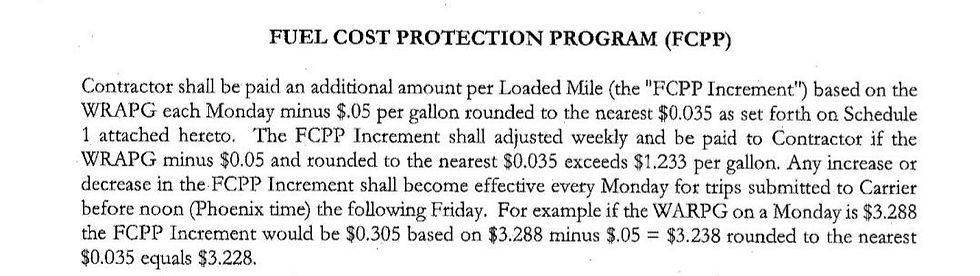
WRAPG minus $0.05 per gallon
That means before any fuel protection is calculated, the program reduces the baseline fuel price by five cents.
What That Means in Practice
Let’s start with a simplified example.
If the weekly fuel index (WRAPG) is:
$3.28 per gallon
The formula immediately reduces it:
$3.28 → $3.23
Fuel protection is then calculated from that lower number.
The Missing Definition
There’s another issue that only becomes obvious when you read the contract closely.
The Fuel Cost Protection Program depends on a variable called WRAPG.
It’s the foundation of the entire formula.
But in the version of the agreement I was given, WRAPG is never actually defined.
After digging into older versions of the ICOA, I found that an earlier version contained a separate section unrelated to fuel that appears to have included the only definition of WRAPG. That section was later removed, and the definition appears to have been removed with it.
What remains is a contract that still uses WRAPG to calculate compensation — without ever explaining what it means.
Without a definition:
drivers cannot independently verify the number,
the formula cannot be fully audited from the contract alone,
and the baseline used for fuel protection is effectively controlled from one side.
In plain terms: the entire fuel protection system depends on a number the contract does not define.
The “Optional” Fuel Card That Isn’t Really Optional
The agreement states that drivers are not required to purchase fuel through the carrier or use the carrier’s fuel card.
On paper, that sounds like freedom of choice.
But the structure of the program tells a different story.
The contract builds in multiple incentives that push drivers toward using the carrier’s fuel network:
A $0.05 per gallon discount at participating locations
An additional $0.05 per gallon rebate if all fuel is purchased within the network for the month
At first glance, that looks like a reward for loyalty.
But it also creates pressure to avoid fueling outside the network—even if better pricing exists elsewhere.
Selective Networks and Hidden Tradeoffs
The agreement names specific participating networks and excludes others.
That detail matters.
Some independent or franchise-based networks (such as One9 locations) operate differently and may not align with the carrier’s pricing structure.
The result is subtle but important:
Drivers are steered toward locations that fit the carrier’s pricing model—not necessarily the lowest price available to the driver.
From 5¢ to 10¢ — What’s Actually Being Offered?
On the carrier’s website, the fuel program is currently advertised as:

“10 cents per gallon off the pump price at our network locations.”
At face value, that sounds like a clear and consistent benefit.
But the contract shows that this “10¢” is not a single, simple discount.
Instead, it is made up of multiple pieces:
$0.05 off at the pump
$0.05 rebate, only if the driver fuels exclusively within the network for an entire month
That second portion is:
conditional,
delayed,
and dependent on behavior.
At the same time, the Fuel Cost Protection Program calculates compensation using:
WRAPG minus $0.05
Which means the same nickel is also removed from the baseline used to determine fuel-related pay.
⚠️ Why This Matters
When viewed together, the advertised “10¢ discount” becomes more complex than it appears:
part of it is conditional,
part of it is delayed,
and part of it is built into the compensation formula itself.
That makes it difficult for a driver to determine:
how much of the discount is actually realized,
when it is received,
and how it interacts with the broader pay structure.
Now Compare That to Real Fuel Prices
This is where the issue becomes much more serious.
At the time of writing, publicly reported diesel prices are running well above the upper end of the Fuel Cost Protection Program’s scale.
In other words, the real world has moved beyond the chart.
The Scale Doesn’t Match Reality
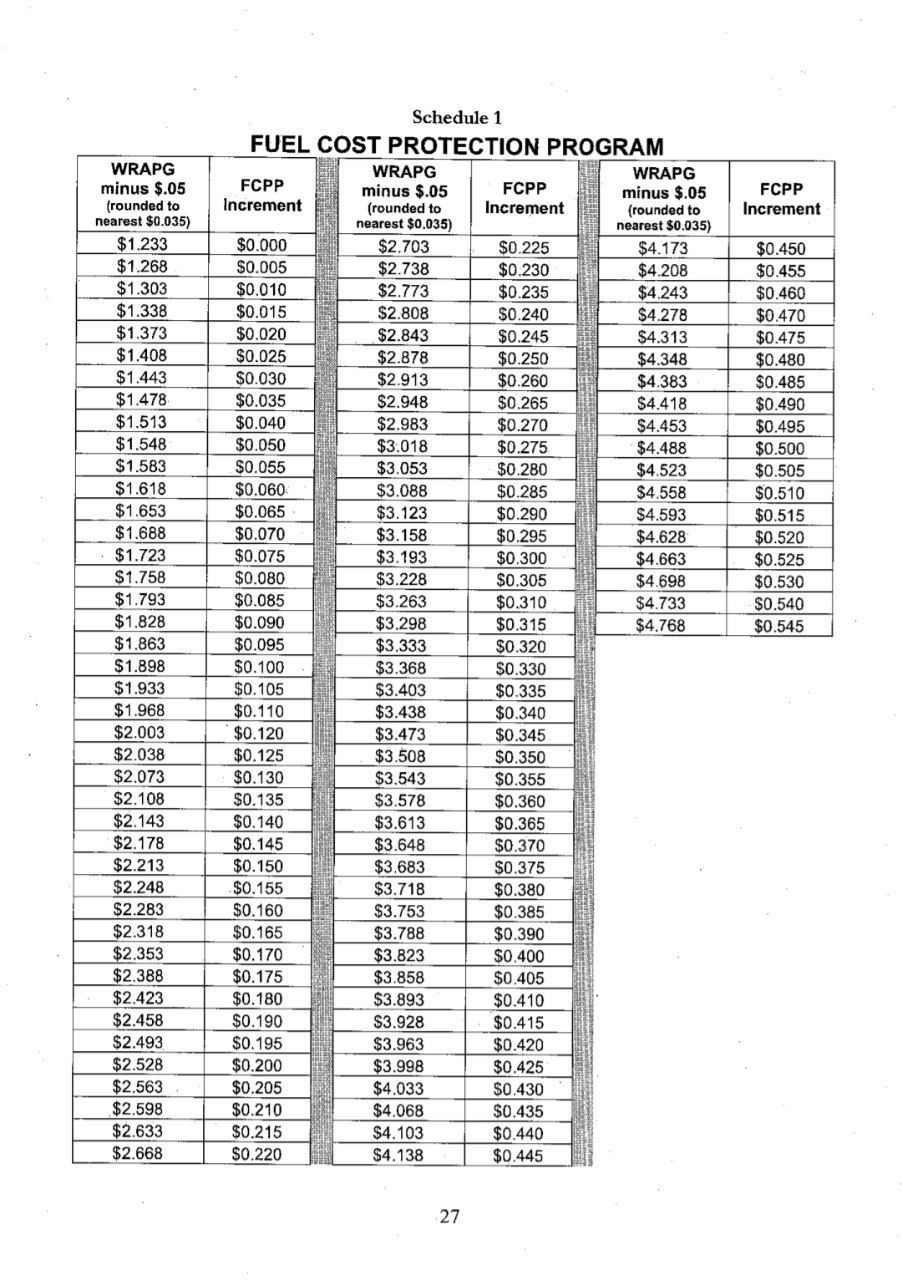
The Fuel Cost Protection Program is based on a fixed schedule tied to WRAPG values.
But that schedule tops out at approximately:
$4.76 per gallon (after the built-in $0.05 reduction)
That means:
the protection scale ends below current real-world fuel prices.
What Happens When Reality Exceeds the Scale?
If real-world diesel is around:
$5.60 per gallon
But the protection system only recognizes values up to:
$4.76
Then the system is no longer tracking actual fuel costs.
The gap looks like this:
Real-world fuel: $5.60
Max protected level: $4.76
Unaccounted difference: $0.84 per gallon
Real Diesel vs FCPP Scale
REAL DIESEL PRICE: $5.60
██████████████████████
FCPP MAX SCALE: $4.76
███████████████
GAP: $0.84 ◀ MISSING COVERAGE
Translation in Plain English
The program stops keeping up before fuel prices do.
Putting It All Together
At this point, multiple layers are working at the same time:
The 5¢ “discount” is subtracted before compensation is calculated
The protection scale does not reach current market fuel prices
The key variable (WRAPG) is not defined in the contract
Incentives steer drivers toward specific fuel networks
The advertised “10¢ discount” is split across conditions, timing, and formula structure
Each of these reduces clarity.
Together, they make it difficult for a driver to fully understand—or verify—how fuel-related compensation is actually being calculated.
Final Thought
This isn’t about interpretation.
It’s about math, structure, and transparency.
If the formula isn’t defined, the scale doesn’t match reality, and the discount is built into the deduction, then the question becomes unavoidable:
How much of the actual fuel cost is the program really protecting?

Comments