


The Squeaky Wheel Got Sued: CBS, Chameleon Carriers, and My Knight-Swift Safety Paper Trail

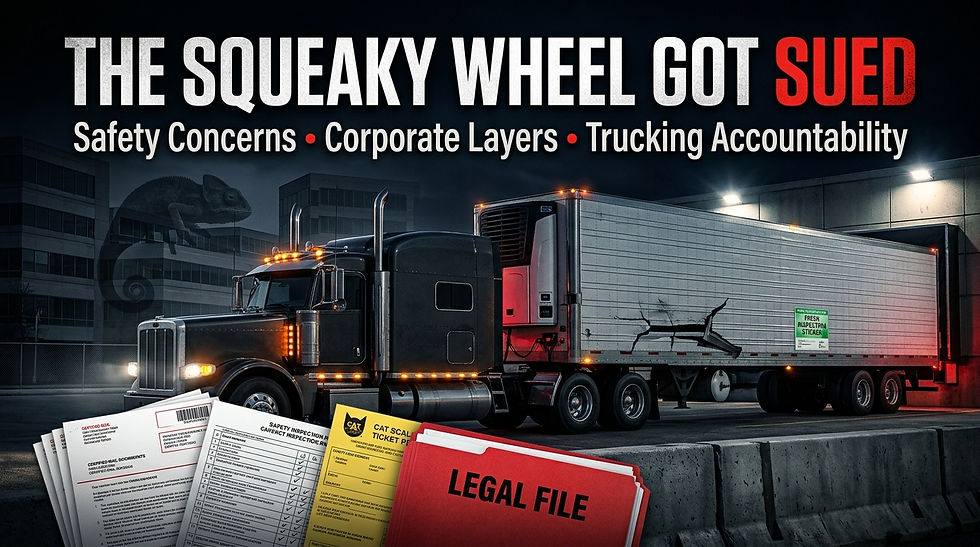
When Trucking Safety Gets Buried in Paperwork: CBS’s Chameleon Carrier Investigation and My Knight-Swift Paper Trail
CBS’s recent trucking investigations put a national spotlight on a problem that truck drivers have talked about for years: in modern freight, danger often hides behind paperwork.
In its 60 Minutes investigation, CBS described “chameleon carriers” as trucking operations that shed one identity for another after safety violations, allowing old problems to disappear behind a new name, new registration, or new DOT number. The story focused on Super Ego Holding and related companies, with regulators and former employees describing a system where corporate layers, lease-to-own contracts, dispatch pressure, and safety shortcuts all worked together in a way that put drivers and the public at risk. (CBS News)
CBS also reported that FMCSA has only hundreds of investigators watching hundreds of thousands of trucking companies, while federal officials described a “front door problem” in stopping bad actors before they enter or re-enter the system. (CBS News) A separate CBS Sunday Morning-related release discussed a Christmas Eve crash involving a semitrailer hauling a C.H. Robinson load, tying that story to the same national conversation about chameleon carriers, broker accountability, and deadly safety failures. (GlobeNewswire)
My story is not identical. I am not saying Knight-Swift is the same thing as the companies CBS profiled. What I am saying is more specific: the same kind of accountability gap can exist when a large carrier system layers operating companies, lease-purchase trucks, contractor status, dispatch control, equipment control, and corporate legal departments in a way that leaves the driver holding the risk.
In August 2023, I prepared a PDF documenting what I experienced with a Knight trailer, a questionable annual inspection sticker, an ignored safety complaint, a worsening trailer defect, an overweight reload situation, and a later bald tire that failed my pre-trip inspection. I mailed that PDF, along with other documents, to Timothy Overton on August 29, 2023. My mailing was signed for. My concerns were not meaningfully addressed by Knight-Swift’s corporate legal team. The attached PDF is part of that paper trail.
The issue was not one bad day. It was a pattern.
The PDF begins with a trailer I picked up at Publix in Orlando and brought to the Knight Transportation terminal in Lakeland, Florida. On the morning of August 14, 2023, while still attached to that trailer, I discovered a brand-new Knight PM/annual inspection sticker dated that same day. According to my account, the trailer had remained connected to my truck, I had been nearby doing generator maintenance, and visible issues remained present, including a torn mudflap and a crack in the side rail. The PDF includes photos of the inspection decal and the trailer.
That matters because federal rules do not treat annual inspections as decorative stickers. Under 49 CFR § 396.17, commercial motor vehicles must pass a periodic inspection at least once during the preceding 12 months, and documentation must certify that the vehicle passed the inspection. (eCFR) Under 49 CFR § 396.13, before driving, the driver must be satisfied that the vehicle is in safe operating condition. (eCFR)
That is the first comparison point with the CBS stories: paper compliance is not the same thing as safety. A clean-looking file, sticker, entity name, or DOT profile does not mean the equipment, driver, or operation is actually safe.
The driver becomes the last safety department.
After leaving Florida, the crack worsened on the way toward Chicago. I stopped at the Indianapolis terminal, reported the problem, and the load ultimately had to be transloaded. The PDF documents my account that I asked for the damaged trailer to be locked out or tagged so another driver would not take it. According to the PDF, that did not happen. Later, I found the same broken trailer connected to another contractor’s truck.
Federal maintenance rules are built around a simple concept: unsafe equipment should not just be passed along until someone else catches it. Under 49 CFR § 396.7, a motor vehicle must not be operated in a condition likely to cause an accident or breakdown. (eCFR) Under 49 CFR § 396.11, when a driver reports a defect likely to affect safe operation, the motor carrier or its agent must repair it or certify that repair is unnecessary before requiring or permitting operation again. (eCFR)
That is the second comparison point with CBS: the person with the CDL often becomes the final firewall between corporate pressure and public danger. In the CBS 60 Minutes story, drivers described being pushed to keep moving despite safety, pay, or compliance concerns. One driver said the company would have him “do anything to get the money no matter what the risk,” while CBS also reported allegations involving altered rate confirmations and excessive lease-related charges. (CBS News)
In my case, I was not describing a foreign chameleon carrier with duct-taped DOT numbers. I was describing a major carrier system where the person actually holding the CDL was still the one forced to say: no, this trailer should not go; no, this overweight setup should not move; no, this bald tire cannot be “limped” down the interstate.
The overweight load was the cleanest example.
After the damaged trailer issue, the load was transloaded in Indianapolis. According to my PDF, the cargo was not reloaded in the same pattern, and the axle weights came out wrong. I documented the CAT scale tickets and explained that the drive axles were thousands of pounds overweight. The PDF then describes a phone exchange where I was told to slide the tandems and run it, with someone suggesting Knight would pay any tickets. I refused.
That moment deserves attention because it strips away the corporate fog. This was not a complicated legal theory. It was not a technical contract dispute. It was a driver being asked, in my account, to move an illegal load because moving freight mattered more than doing it correctly.
FMCSA’s coercion rule matters here. Federal regulation prohibits motor carriers, brokers, shippers, receivers, transportation intermediaries, and their representatives from coercing a commercial driver to operate in violation of covered safety regulations. The FMCSA also says drivers may file written complaints when they believe they were coerced into violating those rules. (eCFR)
CBS’s chameleon-carrier reporting focused on companies using new identities to outrun old safety histories. My experience raises a related question: what happens when the identity does not change, but responsibility still gets scattered across terminals, dispatchers, breakdown lines, contractors, lease paperwork, and corporate legal silence?
This is where “chameleon” becomes more than a DOT-number trick.
The classic chameleon carrier changes names, ownership paper, DOT numbers, or corporate registration to escape enforcement history. FMCSA has recognized reincarnated or affiliated carriers as a safety issue for years, including rules allowing enforcement histories to be consolidated and certain carriers placed out of service when they reincarnate or affiliate to avoid compliance. (FMCSA) FMCSA has also described enforcement tools aimed at carriers or company officers with patterns of purposely violating federal safety rules. (FMCSA)
But the public should understand a broader danger: corporate layering can create chameleon-like accountability even when the same brand stays painted on the trailer.
In my situation, I was a lease-purchase contractor working inside the Knight-related system. Knight controlled the freight opportunities, trailers, dispatch flow, breakdown process, and practical ability to keep earning revenue. Yet when I raised serious safety and legal-operability concerns, the concerns were not fixed in a way that protected me, the next driver, or the public. Instead, after my contract relationship deteriorated and I could no longer continue working legally or financially, Knight-related entities sued me in Maricopa County. That litigation is still ongoing.
That is the part that deserves public scrutiny.
The squeaky wheel did not get the grease. It got pushed out and sued.
The economic pressure is part of the safety story.
CBS’s 60 Minutes segment did not treat lease-purchase economics as separate from safety. It reported that drivers described negative pay, excessive fees, altered pay documents, and pressure to keep moving. (CBS News) That matters because a broke driver is easier to pressure than a secure one.
My PDF shows the same kind of pressure from a different angle. I documented days of delay tied to equipment and load problems, minimal compensation for sitting, uncertainty about breakdown pay, lost revenue, and pressure to choose between waiting unpaid, driving empty miles without proper compensation, or moving freight under conditions I believed were unsafe or illegal.
Safety is not just brakes, tires, and logs. Safety is also whether the business model punishes the driver for saying no.
When a contractor has a truck payment, fuel costs, insurance costs, maintenance exposure, and no real control over freight, “just refuse the load” is not as simple as it sounds. The driver may have the CDL, but the carrier has the freight pipeline. That imbalance is exactly where unsafe pressure can grow.
What I want regulators, reporters, and the public to ask.
The CBS stories are important because they show how extreme the problem can become when enforcement history is hidden behind new companies. But my experience shows why the investigation should not stop at the most obvious chameleons.
The real questions are bigger:
Who controls the equipment?
Who controls the freight?
Who controls the driver’s income?
Who benefits when a driver keeps moving?
Who pays when the driver refuses?
Who gets sued when the relationship collapses?
And when a driver sends documented safety concerns to corporate legal, who is responsible for making sure those concerns do not disappear into a file cabinet?
CBS helped put America’s attention on chameleon carriers. My paper trail shows another side of the same industry problem: safety concerns can be documented, mailed, signed for, and still ignored when the structure is built to protect the company before it protects the road.
That is not just a driver dispute.
That is a public safety issue.


Comments